THE #1 SUPPLEMENT EVERY HIGH-ACHIEVING WOMAN WITH A TOUCH OF ADHD NEEDS IN HER HANDBAG
Oct 08, 2026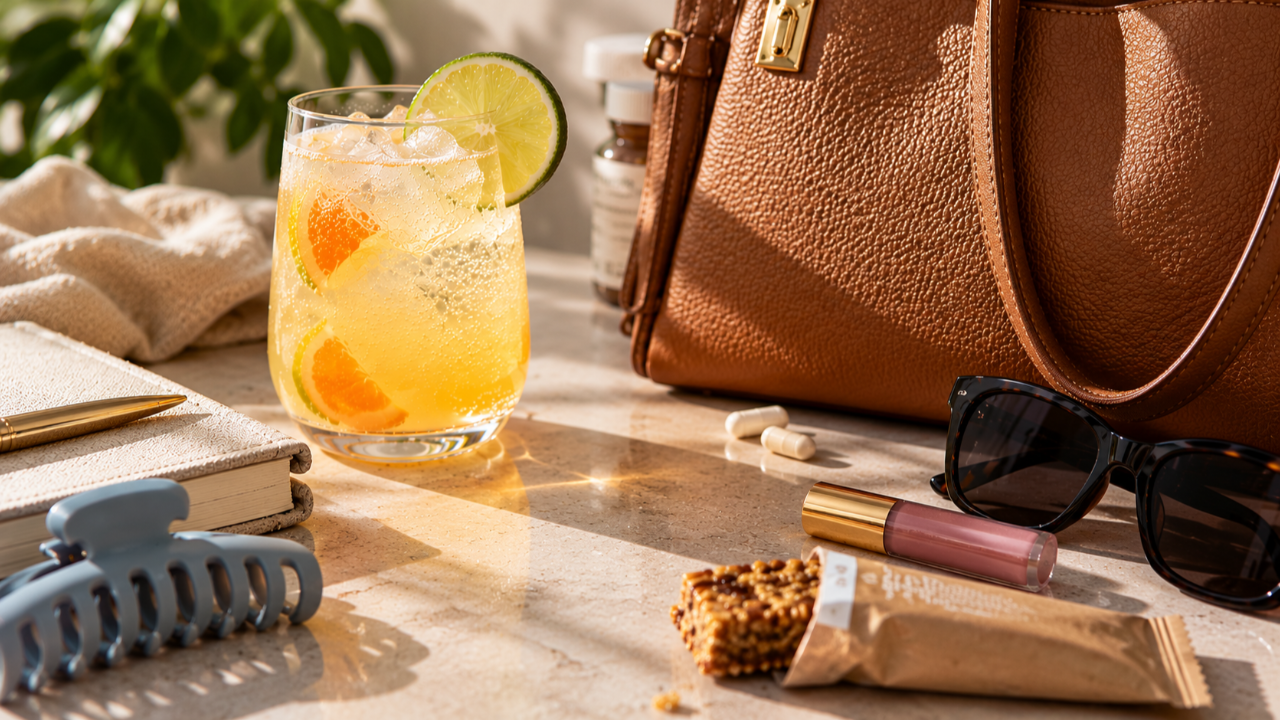
Hint: it’s not magnesium.
If you were to look inside my handbag, you’d probably be underwhelmed. I'm a low maintenance girlie in that respect, so I have my staples, a low-tox lip balm, some emergency protein like a protein bar or beef jerky, and one supplement that I absolutely never leave the house without… l-theanine. Always l-theanine.
There’s some in my handbag, some in my travel bag, some at home, and if I’m getting on a plane, you can pretty much guarantee it’s coming with me. Receipts, however? Absolutely not. We know I don’t touch those.
Because for my brain, L-theanine feels a little like a giant exhale washing over my nervous system, without dulling down the slightly unhinged part of me that I actually quite like. It’s an absolute game changer… and I have a crazy overcaffeinated version of me to thank for discovering it!
The coffee that sent my nervous system into another dimension
I’d gone 6 years without drinking caffeine and had only started drinking coffee again about 3 weeks earlier, so one could say I was already hypersensitive to caffeine… then I was at a conference and somehow accidentally ordered a 4-shot coffee!
Within what felt like minutes, my hands were shaking, my heart was pounding, my brain was going approximately 600 kilometres per hour, and every thought I had apparently needed my immediate attention. All of this at a conference, where I was trying to look like a composed professional.
You know that very fine line where caffeine stops making you feel switched on and suddenly you can hear colours? I had crossed it.
I turned to my friend next to me who could tell by the look on my face (and probably how wide-eyed I was), that I was wired, and offered me an L-theanine. Within about 15 minutes, I felt this calmness cover my entire body. My brain was still online. I could still think clearly. I still felt completely like myself. The frantic edge had just softened, the shaky hands had left the building.
Obviously, as someone who cannot experience something interesting physiologically without immediately needing to understand the mechanism behind it, I went down the research rabbit hole…
So, what actually is L-theanine?
L-theanine is an amino acid found naturally in tea leaves, particularly green tea. Unlike the amino acids we usually talk about in relation to protein and muscle, this one is incredible for what it does in the brain.
It crosses the blood-brain barrier, and experimental research has explored its effects on glutamate signalling and neurotransmitter systems involving GABA, dopamine and serotonin. Glutamate is a major excitatory neurotransmitter, while GABA helps inhibit neural activity. These pathways are part of how the brain manages stimulation. L-theanine has been shown to act on changes in stress, brain activity and attention actually look like (PMID: 26797633).
The experience people often describe when taking this is calm without feeling dulled down. Or, perhaps more accurately for the women reading this, your brain still has horsepower, you’ve just got your hands back on the steering wheel.
Which brings me to one of my favourite pieces of research.
The study that made me pay even more attention
In a randomised, double-blind, placebo-controlled crossover study, 34 healthy adults were given an L-theanine-based drink or placebo before completing a cognitively demanding multitasking challenge. The drink contained 200 mg of L-theanine alongside small amounts of other ingredients, including chamomile.
The researchers weren’t just asking people whether they “felt calmer”. They measured subjective stress, salivary cortisol and brain activity. Participants had a significantly lower reported stress response at the one-hour assessment, and their cortisol response to the challenge was lower three hours after dosing. Researchers also observed increased resting alpha-wave activity at two hours in participants with higher trait anxiety (PMID: 26797633).
As someone that runs on high adrenaline and cortisol (hello neurospicy, high functioning ladies), this was incredibly interesting and I could viscerally feel the cortisol drop in my body. Not only that, but the anxious, overthinking shift was massive too, which is what we see observing the study above too. The increased alpha-wave activity of the brain is associated with relaxed wakefulness, which is incredibly supportive if you are needing to focus without the overwhelm, complete tasks without wanting to jump tabs every 5 minutes and be present and focused in meetings or presentations. So you can be competent, prepared and genuinely excited about what you are doing, while your physiology makes the whole experience feel far calmer.
A separate trial of L-theanine alone also found that 200 mg reduced the heart-rate response to an acute (short term) stressor, results suggesting reduced activation of the sympathetic nervous system… aka that triggering coworker that just gets on your nerves suddenly doesn’t bother you as much (PMID: 16930802).
For the woman who looks composed from the outside but feels like she is vibrating internally, you can see why I’m interested in support at that physiological level.
The further down the rabbit hole I dove, the more interesting things got! I discovered l-theanine and caffeine actually work beautifully together!!
Why L-theanine and coffee are such a power couple
This is probably my favourite way to use L-theanine, because while I love what caffeine can do for cognition and focus, there is a fine line between ‘ohhhh, my brain is online’ and ‘I have reorganised my entire business, sent 14 voice notes and developed a heart palpitation’. Especially if you already have a neurospicy brain, higher baseline anxiety, or a tendency to treat coffee as breakfast when life gets busy (PMID: 24549722).
So here’s how they work as a power couple: studies of L-theanine alongside caffeine have found improvements in attention, accuracy, task switching and resistance to distraction compared with placebo. One trial found improvements in both the speed and accuracy of an attention-switching task, along with reduced susceptibility to distracting information during a memory task (PMID: 18681988)
Think about what those skills mean in your day. You are moving from a meeting to writing an email, answering a question for someone who just pops up at your desk, then trying to pick up the thought you were halfway through. Or you are reading something important while someone is talking beside you, and you keep getting to the end of the paragraph without actually taking it in. Having more energy is one thing, being able to direct your attention is another.
The best part about pairing the l-theanine with the coffee is that it doesn’t cancel out the caffeine effects! I drink coffee intentionally as much as I do for the joy. I want the alertness, the enhanced focus, the ‘let’s fucking go’ energy that my morning coffee gives me, but I would simply prefer it without my nervous system vibrating through the chair.
That is the sweet spot I’m looking for: stimulated enough to focus, settled enough to direct it.
And yes, my neurospicy girls should be paying attention
If you have ADHD, you probably know that ‘I can’t focus’ doesn’t adequately describe what is happening in your brain. Sometimes you can’t direct your attention onto something to save yourself. Other times you can hyperfocus so aggressively that three hours disappear and apparently eating lunch was an optional side quest.
Throw stress, poor sleep and too much caffeine into that brain and you can end up feeling simultaneously exhausted, overstimulated, distracted and somehow still incapable of starting the one thing you actually need to do.
This is where the research gets particularly interesting! A 2026 systematic review and meta-analysis brought together 31 randomised controlled trials involving 1,168 participants to investigate L-theanine’s effects on cognition and mood. Its attention analysis found that a single 200 mg dose, taken 30–60 minutes before testing, significantly improved choice reaction time in healthy adults (PMID: 42410082).
Choice reaction time involves recognising what you’re being presented with and selecting the correct response. So we’re looking at how effectively you process information and respond to it, which is incredibly relevant when your day involves answering questions, making decisions and switching between approximately 84 things that all apparently need you right now.
Then there’s a double-blind, placebo-controlled crossover trial that was done in 27 healthy young adults. Researchers tested 100, 200 and 400 mg of L-theanine and found that 400 mg sped up an electrical brain response associated with processing relevant auditory information during a selective attention task (PMID: 32777998).
Basically, they were measuring how quickly the brain processes the sound you’re supposed to be paying attention to. The significant finding was at 400 mg and in that specific brain-response measure, giving us interesting insight into what L-theanine can do beyond simply making someone feel calmer.
And there is ADHD-specific research too! There is a fascinating proof-of-concept trial looking specifically at L-theanine and caffeine in five boys with ADHD. The combination improved measures of sustained attention and overall cognition, with a promising trend towards improved inhibitory control, the ability to stop a response.
Brain imaging also showed reduced task-related activity in the default mode network, which is associated with internally directed thought and mind wandering. That suggests the combination may help reduce some of the internal distraction that pulls attention away from a task (PMID: 32753637).
Because sometimes the interruption is coming from inside your own head. You sit down to write an invoice, remember a podcast you wanted to listen to, start thinking about the washing, and suddenly you have spent forty minutes reorganising your wardrobe because you walked into your bedroom to check for any dirty clothes (and the invoice is still waiting).
Anecdotally, this is something I’ve seen with clients when they take l-theanine too. They often describe feeling calmer and more able to direct their attention, without that heavy or sedated feeling that would be completely unhelpful when you’ve still got a business to run, children to collect, a presentation to give or approximately 84 things sitting in your inbox.
The dose matters, and this is where supplements often lose me
Here’s the part I want you to pay attention to, because dose matters. You can have the right ingredient on a supplement label and still have an amount that bears very little resemblance to the dose needed for the result you bought it for.
I’m always looking for the therapeutic dose (aka the one that has been shown to be most effective), which as we’ve seen in the literature is 200mg. So this is the dose I prescribe to clients and carry around with me at all times!
Just be sure to check with your medical provider on whether it will be safe for you to take.
Why it has permanent handbag status
I use L-theanine strategically. I’ll pair it with coffee when I want the cognitive lift without tipping myself into overstimulation. I keep it close when I travel because airports, disrupted routines, caffeine and an already-busy brain are quite the nervous-system cocktail. It’s also one of those tools I like having available on particularly demanding days when I need to be switched on for a long period of time and might be feeling overwhelmed by the size of my to-do list.
It has become one of my favourite examples of what I mean when I talk about supporting your capacity. I want you to be able to enjoy your creative mind that gives you a million ideas, your work and the things you are excited to show up for, while feeling comfortable and calm inside the body you are doing them in.
Your intensity, your enthusiasm, the way your brain makes connections and comes up with ideas, there is so much to love about that. Being able to direct it without feeling constantly wound up is what makes this little amino acid so incredible!
So yes, if you look inside my handbag, you’ll find my wallet, a low-tox lip balm, emergency beef jerky and 200 mg L-theanine, because being a high-achieving eldest daughter with a touch of neurospiciness means I am learning to take care of myself without sacrificing my goals and dreams!
Yours in Health & Happiness,
Sheree xo
References
Dassanayake, T. L., Kahathuduwa, C. N., & Weerasinghe, V. S. (2022). L-theanine improves neurophysiological measures of attention in a dose-dependent manner: A double-blind, placebo-controlled, crossover study. Nutritional Neuroscience, 25(4), 698–708. https://doi.org/10.1080/1028415X.2020.1804098
PMID: 32777998
Gerolymos, C., Saddier, E., Boyer, L., & Fond, G. (2026). Cognitive and affective effects of L-theanine: A systematic review and meta-analysis of 31 randomized trials. Molecular Psychiatry. Advance online publication. https://doi.org/10.1038/s41380-026-03727-9
PMID: 42410082
Kahathuduwa, C. N., Wakefield, S., West, B. D., Blume, J., Dassanayake, T. L., Weerasinghe, V. S., & Mastergeorge, A. (2020). Effects of L-theanine–caffeine combination on sustained attention and inhibitory control among children with ADHD: A proof-of-concept neuroimaging RCT. Scientific Reports, 10, Article 13072. https://doi.org/10.1038/s41598-020-70037-7
PMID: 32753637
Kimura, K., Ozeki, M., Juneja, L. R., & Ohira, H. (2007). L-theanine reduces psychological and physiological stress responses. Biological Psychology, 74(1), 39–45. https://doi.org/10.1016/j.biopsycho.2006.06.006
PMID: 16930802
Owen, G. N., Parnell, H., De Bruin, E. A., & Rycroft, J. A. (2008). The combined effects of L-theanine and caffeine on cognitive performance and mood. Nutritional Neuroscience, 11(4), 193–198. https://doi.org/10.1179/147683008X301513
PMID: 18681988
Urry, E., & Landolt, H.-P. (2015). Adenosine, caffeine, and performance: From cognitive neuroscience of sleep to sleep pharmacogenetics. In P. Meerlo, R. M. Benca, & T. Abel (Eds.), Sleep, neuronal plasticity and brain function (pp. 331–366). Springer. https://doi.org/10.1007/7854_2014_274
PMID: 24549722
White, D. J., de Klerk, S., Woods, W., Gondalia, S., Noonan, C., & Scholey, A. B. (2016). Anti-stress, behavioural and magnetoencephalography effects of an L-theanine-based nutrient drink: A randomised, double-blind, placebo-controlled, crossover trial. Nutrients, 8(1), Article 53. https://doi.org/10.3390/nu8010053
PMID: 26797633
Join the SHWellness Newsletter
Stay connected in the SHW Community with all the latest wellness tips, hacks and updates delivered right to your inbox each week!
We hate SPAM. We will never sell your information, for any reason.
