WHY SAFFRON CAUGHT MY NEUROSPICY ATTENTION…
Oct 08, 2026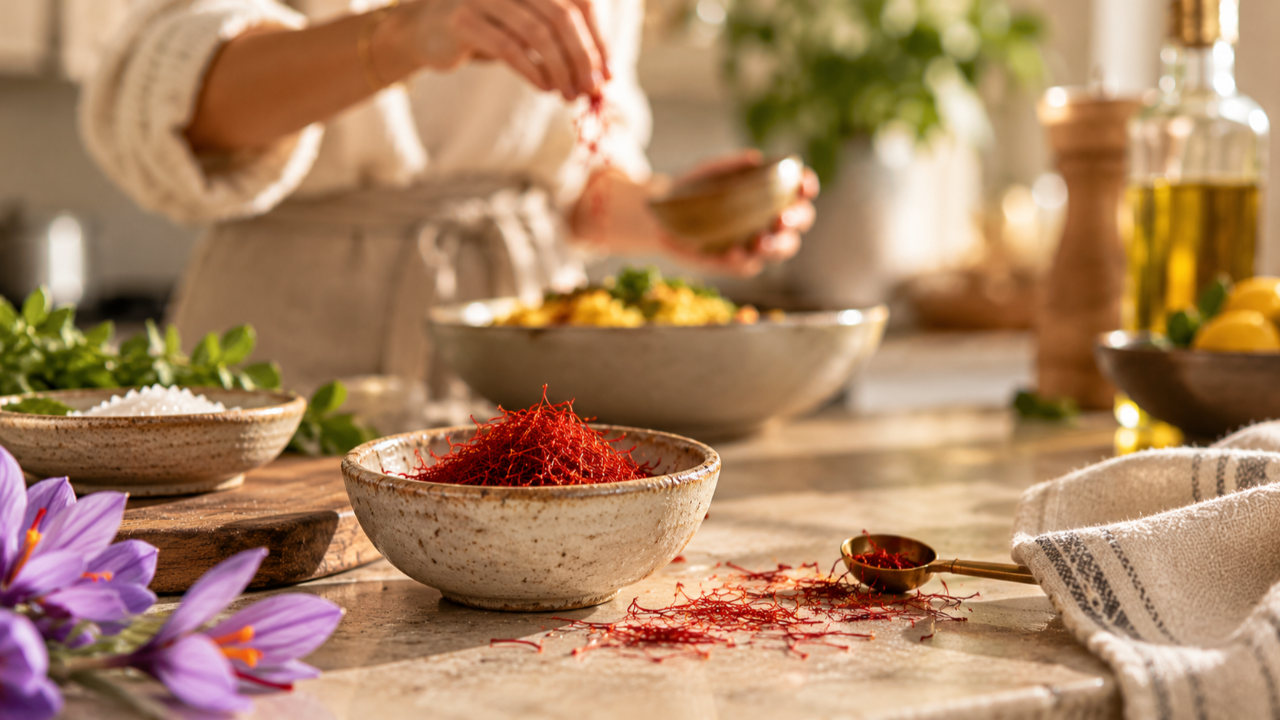
If you have ADHD or suspected ADHD, listen up!
I have spent enough time in my own brain to be fairly convinced ADHD has entered the group chat of my body… whilst this is a self-diagnosed, undiagnosed situation, it’s been an interesting journey nonetheless.
If you’d have said this to me when I was a child or even 5 years ago I wouldn’t have believed you, (my mum still thinks I’m making it up). I would’ve told you it was just a very dysregulated nervous system.
I was the good girl in school, high achieving academic, ‘pleasure to have in class’ vibe, that was also always told off for being too loud and distracting the other students by talking too much… just the tip of the ice-berg when you start looking at how common ADHD is in women, but when you do, it explains a lot!
The hyperfocus, the accidental side quests or 27 different tangents I will go on when I’m telling you a ‘short story’ or the 47 tabs open I have at any point in time on both my computer and in my brain. It’s the hyperactivity in the mind that makes me wanna execute 12 different ideas at once, get distracted by lunchtime and finish tasks annoyingly to 90%.
It makes sense that it feels like a nervous system thing, because the adrenaline filled monkey that’s juggling, bench pressing, ordering flowers and running a business and also your mind is also somewhat exhausted and can’t slow down at the same time. Living with a brain that can hold a ridiculous amount, until it cannot find the sunglasses that are sitting on its own head can be frustrating at times though!
And look, because I am not formally diagnosed, medication has never really been something I have personally wanted to pursue. Zero judgement if that is part of your support plan, medication can be life-changing for people. It is just not the route I have wanted to take for myself, which has made me incredibly curious about other ways to support my brain, my mood, my focus and my nervous system.
Especially because so many of my clients are neurospicy too <3
So when I started seeing saffron come up in the literature around ADHD, mood and anxiety, I went down a little rabbit hole (I see my fellow neurospicy ladies nodding along).
Because saffron is not exactly the first thing you think of when you think ‘brain support’. I personally thought of it in the context of food; think expensive spice, risotto, paella, perhaps something you buy for one recipe and then guard in the pantry like it is a family heirloom.
But this tiny red spice has some genuinely interesting research behind it.
I have now been trialling it myself for two months. It has not been one of those supplements where I woke up on day three with a completely different personality, which is probably a good thing because that would be mildly concerning, but I have noticed more stability. I feel less up and down, less hyperactive, and just a little more grounded in myself.
That is obviously my experience, not a promise that saffron will do the same thing for everyone but it is enough for me to keep paying attention.
First, what actually is saffron?
Saffron comes from the little red threads, called stigmas, inside the Crocus sativus flower. Each flower only produces three of them, and they are picked by hand, which explains why it costs what it costs.
The studies we are talking about are not using a few threads sprinkled into dinner, unfortunately. They use standardised saffron extracts, meaning the researchers know exactly how much of the active compounds people are getting. The main compounds researchers are interested in are crocin, crocetin and safranal. These appear to be involved in saffron’s antioxidant and anti-inflammatory effects, as well as how it may influence chemical messaging in the brain (PMID: 38424688).
Which is where this gets interesting…
How saffron and serotonin are linked
You have probably heard serotonin called the “happy hormone”, which is a nice little headline, but it does not quite do it justice.
Serotonin is one of the chemical messengers your brain uses to communicate. It is involved in mood, sleep, appetite, gut function, anxiety and emotional regulation. It helps carry messages between brain cells, a little like the person in the group chat making sure the important information does not get lost between the memes, the voice notes and someone changing the subject completely.
Once serotonin has passed on a message, it is usually taken back up by the cell that released it, this is called reuptake.
One of the theories around saffron is that it may gently influence serotonin reuptake, meaning serotonin may stay available in the space between brain cells for a little longer. It also appears to have effects on inflammation and oxidative stress, both of which matter because an inflamed, run-down body and an overwhelmed brain rarely make a peaceful team (PMID: 38424688).
This is part of why researchers became curious about saffron for mood and anxiety in the first place.
A recent meta-analysis of 34 randomised controlled trials found saffron supplementation improved self-reported depression and anxiety scores. The part I want to be transparent about is that clinician-rated measures did not show the same consistent effect, and the studies varied quite a lot in quality and design. So, there is enough here to be interested, but not enough to make wild claims or suggest it replaces mental-health care (PMID: 41693488).
The ADHD research that really caught my attention
This is the part that made me go, okay wait, this is actually really interesting…
In one double-blind study, 54 children and teenagers with ADHD were split into two groups. One group took saffron and the other took methylphenidate, aka Ritalin, for six weeks.
At the end of the study, both groups had improved by a similar amount.
Let that sink in.
The kids taking saffron saw similar improvements in their ADHD symptoms to the kids taking Ritalin (PMID: 30741567).
Now, this does not mean saffron is a replacement for medication, and I am absolutely not suggesting people stop their medication and swap to saffron. But it does mean that, in this small study, saffron held its own well enough against one of the most commonly prescribed ADHD medications for researchers to take it very seriously.
Then it gets even more interesting…
Another study looked at what happened when saffron was added alongside methylphenidate. Seventy children and teenagers with ADHD were given methylphenidate, but one group also took saffron for eight weeks.
Both groups improved, but the group taking methylphenidate and saffron had bigger improvements in their ADHD symptoms by weeks four and eight, according to both parents and teachers (PMID: 33715085).
And because I know we cannot only use children’s research to make decisions for grown-ass neurospicy women trying to run businesses, remember their passwords, train for HYROX and keep the kitchen vaguely functional, there is adult research too.
In a six-week study, adults with ADHD took methylphenidate with either saffron or a placebo. The group taking saffron reported a greater improvement in their ADHD symptoms by the end of the study (Pazoki et al., 2022, DOI: 10.1016/j.aimed.2022.01.002).
A 2024 systematic review looked at the clinical research available so far and came to a similar conclusion: saffron is a promising option for ADHD, either by itself or alongside conventional treatment. We need more research, yes, but there is enough here to be genuinely curious about it (PMID: 37864351).
So when I say saffron caught my attention, it’s not because some TikTok wellness influencer posted a 90 second review with her affiliate link, it is because we have research showing that it may be helpful on its own, may offer additional support alongside medication, and may have a place in the much bigger conversation around supporting ADHD brains.
That is exciting to me!
Where L-theanine fits into my neurospicy toolkit
Just a little side note (tell me I’m not neurospicy, I can’t even write a blog without taking you on a side quest)...
One other thing I have found really helpful is L-theanine, particularly when my brain is feeling busy or I am carrying that low-level anxiety that makes everything feel a little louder.
For me, saffron has felt more like a steadier, longer-game form of support. L-theanine is more something I reach for when I want to take the edge off that wired-but-tired, mentally busy feeling. It’s also been incredibly supportive in helping me focus. They are different tools, and I have loved having both in my neurospicy toolkit.
Naturally, I have done a proper deep dive on L-theanine too, you can read that one here: [link to L-theanine post - the supplement every high achieving woman should have in her handbag].
How I think about using saffron
Most of the research uses a standardised saffron extract, generally around 28 to 30 mg daily, often split across the day, for somewhere between six and twelve weeks. I’ve been taking a 30mg dose daily now for the last 8 weeks and will continue to see what it does for the remainder of the 12 week period before giving my body a little time off to see if there’s a noticeable difference.
Whilst the research is still ongoing (as it always is), I do think this could be a powerful intervention or potentially alternative option for women with ADHD, as long as it is of a high quality and checked with your medical provider. As someone who probably won’t get a diagnosis or take the medication herself, I’m stoked I found this as a potential alternative.
But, a really important note before you add it to your cart
Saffron can influence serotonin pathways, so it is not something I would want you casually layering on top of an SSRI, SNRI or other medication that affects serotonin without checking first.
We do not have robust research showing exactly how every saffron and medication interaction plays out, but there is enough overlap in how they may work that it is worth having a conversation with your GP, psychiatrist or pharmacist. They can look at your actual medication, dose and health history, rather than you trying to piece it together from the internet.
Saffron is still an active supplement. If you are taking medication for mood or anxiety, are pregnant or breastfeeding, have bipolar disorder, take blood-thinning medication, or are thinking about it for your child, get personalised medical advice before starting it. And please do not stop medication that is helping you because you have read about a spice on the internet (PMID: 42057871).
For now, saffron is in it’s trial error in my mind (quite literally), and I will happily keep you posted, because I love when science gives us another possible way to support women who have spent their whole lives being told their brains are too much, too scattered, too emotional or too hard to manage (maybe they just need support that was built with their actual wiring in mind).
References
- Han, S., Cao, Y., Wu, X., Xu, J., Nie, Z., & Qiu, Y. (2024). New horizons for the study of saffron (Crocus sativus L.) and its active ingredients in the management of neurological and psychiatric disorders: A systematic review of clinical evidence and mechanisms. Phytotherapy Research, 38(5), 2276–2302. https://doi.org/10.1002/ptr.8110
PMID: 38424688 - Mahmoudi, R., Mohammadi-Sartang, M., Servatyari, K., & Rafieipour, N. (2026). Effect of saffron on depression, anxiety and mood disorder: A GRADE assessed systematic review and meta-analysis of 34 randomised controlled trials. Nutritional Neuroscience, 29(7), 816–837. https://doi.org/10.1080/1028415X.2025.2602153
PMID: 41693488 - Baziar, S., Aqamolaei, A., Khadem, E., et al. (2019). Crocus sativus L. versus methylphenidate in treatment of children with attention-deficit/hyperactivity disorder: A randomised, double-blind pilot study. Journal of Child and Adolescent Psychopharmacology, 29(3), 205–212. https://doi.org/10.1089/cap.2018.0146
PMID: 30741567 - Khaksarian, M., Ahangari, N., Masjedi-Arani, A., Mirr, I., Jafari, H., Kordian, S., Nooripour, R., & Hassanvandi, S. (2021). A comparison of methylphenidate (MPH) and combined methylphenidate with Crocus sativus (saffron) in the treatment of children and adolescents with ADHD: A randomised, double-blind, parallel-group clinical trial. Iranian Journal of Psychiatry and Behavioral Sciences, 15(3), e108390. https://doi.org/10.5812/ijpbs.108390
- Pazoki, B., Zandi, N., et al. (2022). Efficacy and safety of saffron as adjunctive therapy in adults with attention-deficit/hyperactivity disorder: A randomised, double-blind, placebo-controlled clinical trial. Advances in Integrative Medicine, 9(1), 37–43. https://doi.org/10.1016/j.aimed.2022.01.002
- Seyedi-Sahebari, S., Farhang, S., Araj-Khodaei, M., Akhondzadeh, S., Naseri, A., Sanaie, S., & Frounchi, N. (2024). The effects of Crocus sativus (saffron) on ADHD: A systematic review. Journal of Attention Disorders, 28(1), 14–24. https://doi.org/10.1177/10870547231203176
PMID: 37864351 - Hasheminasab, F. S., Hajimonfarednejad, M., Najibi, S. M., & Hashempur, M. H. (2026). Adverse events of saffron (Crocus sativus L.): Systematic review of current evidence. Health Science Reports, 9(5), e72212. https://doi.org/10.1002/hsr2.72212
PMID: 42057871
Join the SHWellness Newsletter
Stay connected in the SHW Community with all the latest wellness tips, hacks and updates delivered right to your inbox each week!
We hate SPAM. We will never sell your information, for any reason.
